Contact details:

Eric Kopittke Email: kopittke@tpg.com.au
Blog: www.erickopittke.blogspot.com.au
Brief historical background of the German region
Roman Empire
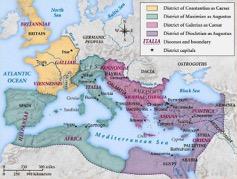
Germani was a term apparently introduced by Julius Caesar and applied to a group of tribes from what is now Belgium and neighbouring areas. Believed to have migrated from east of the Rhine.
The Germanic tribes proved difficult to subdue and the Empire boundaries tended to be the Rhine and Danube Rivers. The Romans established some cities in Germany.
Barbarian Invasions of the Roman Empire (100-500 A.D.)
They conquered the Goths and other Germanic and Slavic peoples. Romans became aware of the Huns in 376 when thousands of Goths crossed the Danube seeking refuge in the Roman Empire.
Germanic tribes moved towards west and south because of pressure from peoples to the east (Huns, Slavs etc) and population pressure. Some of these groups adopted Latin based languages (France, Spain, Italy, …). In the fifth century, Germanic tribes overran Rome
The Kingdom of the Franks (Francia) and the Holy Roman Empire
After the death of Charlemagne, the title passed to his son, Louis the Pious (778-20 June 840). The death of Louis led to war between his sons which was settled by the Treaty of Verdun (August 843), dividing Francia between the three sons: East, Middle and West Francia.
West Francia became France. East Francia became the Holy Roman Empire incorporating Saxon, Italian and Bohemian lands. Middle Francia was fought over by its neighbours for 1100 years.
The title ‘Emperor of the Romans’ was continued by Charlemagne’s successors until 924, and then revived in 962 under Otto the Great. From this time on, the German princes would elect one of their own as King of the Romans
who would later be crowned as Emperor.
Hohenstaufen dynasty
During the Hohenstaufen dynasty (1138-1254) German princes arranged a peaceful eastward settlement into uninhabited or sparsely inhabited areas in the Western Slavic lands. Farmers, traders, craftsmen from the western part of the Empire migrated into these areas which over time were ‘Germanised’. However not all of the Germanic eastward expansion into Slavic areas was peaceful, evidence of which can be seen in names of regions such as Altmark, Neumark, Uckermark, Grenzmark or Steiermark (Styria, Austria); or in the designation of a region as a Markgrafschaft (Margraviate).
Austria
Bavarians and Franks under Charlemagne pushed east in the late 8th century displacing Slavs and Avars. Emperor Otto established the Bavarian Eastern March under Leopold the Illustrious, count of Babenberg, in 976, subsequently to become Austria Österreich – the eastern kingdom. The Babenbergs were Margraves of Austria until 1156. From 1156 to 1453 Austria was a duchy within the Empire The Babenbergs remained as dukes until 1246.
Poland and Prussia
The Knights of the Teutonic Order were invited in 1226 by Duke Konrad of Masovia to Christianise the 'pagan Prussians' in the region bordering the Baltic Sea. The Teutonic Knights grew in power and influence, controlling the Vistula River and hence Polish access to the Baltic Sea. German and Dutch settlers were brought into area. Prussian language and identity ultimately eliminated.
Mongol Invasions 1236-1242
Much of Eastern Europe was brought into the empire of the Golden Horde. Batu Khan and Kadan, grandsons of Genghis Khan, led raids into central Europe in 1241 and 1242. Five armies attacked central Europe. Warring European princes had to cooperate or be destroyed. Poland & Moravia were defeated at Legnica (Liegnitz) 9 Apr 1241 and Henry the Pious, Duke of Silesia was killed. Wenceslaus I King of Bohemia fled back home and successfully defended Bohemia with aid of Thuringia and Saxony but Moravia and Silesia were ravaged.
Hungary was defeated at Mohi 11 Apr 1241 with nearly half of the inhabited places in Hungary destroyed and with the death of 20-40% of the population.
Hanseatic League
The Hanseatic League was a confederation of market towns and merchant guilds in North Western and Central Europe. Established for defence and to promote trade, its origins were with a few North German towns in the late 12th century. The first documented use of the term Hanse was in 1267.
The League grew to dominate trade in the Baltic and North Seas, and along the navigable rivers. The cities of the Hanseatic League operated their own legal system and had their own armies for protection. The operations of the League served to promote the development of industries such as textiles in Germany.
German colonists settled in the eastern cities. The influence of the League diminished after 1450.
Holy Roman Empire
In the 13th century the Holy Roman Emperor came to be elected by a college of Electoral Princes or Electors. Originally consisting of the Archbishops of Mainz, Trier and Cologne, the King of Bohemia, the Duke of Saxony, the Count Palatine of the Rhine, and the Margrave of Brandenburg, over the years the members of the college changed.
The Habsburg dynasty (1278-1918)
In 1251 some Austrian nobles invited King Ottokar of Bohemia to rule Austria. He seized control. Ottokar was married to Margaret of Babenberg. In 1273, Ottokar contested the Imperial throne but Rudolph of Habsburg was elected instead. Ottokar refused to accept the result.
In November 1274 the Imperial Diet at Nuremberg ruled that Ottokar should answer to the Diet and restore all crown estates that had been seized. Ottokar refused to comply and was placed under the imperial ban. War was declared against him in June 1276 and Rudolph laid siege to Vienna. The two rival armies finally met at the Battle on the Marchfeld and on 26 August 1278, Ottokar was defeated and killed. In 1278, Rudolph of Habsburg, Holy Roman Emperor, assumed sole control over Austria as Duke of Austria and Styria. This commenced the Habsburg dynasty’s control over Austria as Dukes and later Archdukes that lasted until 1918.
Poland and Prussia
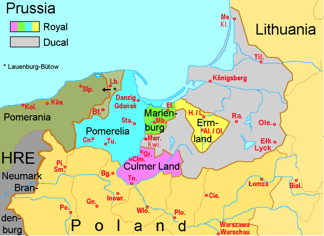
In 1386 Queen Jadwiga of Poland married Grand Duke Jagiello of Lithuania, beginning the personal union of Poland and Lithuania. In 1410 the Polish-Lithuanian forces defeated the Knights of the Teutonic Order in the Battle of Grunwald or Tannenberg. The Teutonic Order became subject to the Polish crown and the area was known as Prussia.
In 1466, Prussia was divided. The western part was ruled directly by the Polish crown. The eastern part was ruled by the Teutonic Order who were vassals of the Polish crown.
Habsburg dynasty (1452 – 1806)
In 1440, the college of Electors elected Frederick V of Habsburg, Duke of Austria, as King of the Germans (Frederick IV). He was crowned Holy Roman Emperor as Frederick III in 1452. The Hapsburgs continued to serve as Emperors until the end of the Empire in 1806.
Reformation and Thirty Years War
In Bohemia Jan Hus (John Huss) a Czech priest preached in Prague and demanded reformation within the church. Following his burning at the stake in 1415, his followers (Hussites) rebelled against their Roman Catholic rulers. Freedom of religion was negotiated in 1436 but declared invalid by Pope Pius II in 1462. Some freedoms remained. Archduke Ferdinand I became King of Bohemia in 1526, bringing Bohemia into the Hapsburg Monarchy.
Other pockets of opposition to the Church had surfaced over the years but had been ruthlessly suppressed.
Martin Luther posted 95 Theses (propositions for debate) concerning abuses within the church in October 1517. These prompted much interest throughout Europe.
It is estimated that by the time of Luther, 90% of the inhabitants of the Czech lands were not Roman Catholics.
In Zürich in Switzerland, the priest Huldrych (or Ulrich) Zwingli began preaching in 1518 on his ideas for the reformation of the church. His ideas gained popularity amongst some of the Swiss cantons.
Jean (John) Calvin moved from France to Geneva in Switzerland in 1536. Calvin’s teachings and writings greatly influenced the Reformation movement across Europe. In Germany they formed the basis of the Reformed church. The views of Calvin and Zwingli on communion were similar but different to those of Luther.
The Anabaptists were groups who rejected infant baptism and believed that only true believers should be baptised.
Many of the Princes of the Empire adopted the Reformation as did the Knights of the Teutonic Order. This led to years of struggle between the Catholic states under the Holy Roman Emperor, Charles V, and a league of Protestant princes. The Peace of Augsburg officially ended the struggle in 1555 and established the principle Cuius region, eius religio (Whose realm, his religion). The princes could select either Lutheranism or Catholicism within their domains
Those subjects or citizens who could not conform to their prince’s religion were permitted to migrate with their possessions to another region where their religion was accepted.
Other groups such as Calvinists and Anabaptists were considered heretics and could be put to death.
In 1618, Ferdinand, Crown Prince of Bohemia later Ferdinand II, Holy Roman Emperor, wanted religious uniformity imposed on his territories. Two Catholic representatives were sent to Prague – thrown out of a castle window and seriously injured.
Thirty years of warfare ensued, initially between the Imperial forces and the Protestant princes but over the years the Empire’s neighbours became embroiled. Ended by Peace of Westphalia 1648 by which principle of Cuius region, eius religio from the Peace of Augsburg reiterated. This time it included the Calvinists. Christians living in territories where they were not of the established religion were permitted to practice their faith in public during specified hours.
In many areas of Germany church records exist only after the Thirty Years War because of the destruction that occurred.
The Knights of the Teutonic Order accepted the Lutheran Reformation with the Grand Master becoming Duke of Prussia.
In 1618 John Sigismund, Elector of Brandenburg became Duke in Prussia by marrying Anna, Duchess of Prussia. Ducal (east) Prussia remained subject to Polish Crown until Friedrich Wilhelm, the Great Elector removed Ducal Prussia from Polish sovereignty in 1657.
In 1701, Elector Frederick III of Brandenburg and Duke of Prussia elevated Ducal Prussia to a kingdom becoming Frederick I King in Prussia.
1740-45 – Frederick II the Great of Prussia annexed Silesia (from Austria).
In 1772, 1793 and 1795 Poland was divided between its neighbours, Prussia, Austria and Russia and ceased to exist.
19th Century
Under occupation by French forces, 16 German states seceded from the Empire and formed the Confederation of the Rhine in 1806, with Napoleon as ‘Protector’. This led to the dissolution of the Empire. A further 19 states later joined the Confederation. The French system of Civil Registration of births, marriages and deaths was generally imposed in the occupied states.
Following the defeat of Napoleon at Waterloo under Wellington and von Blücher, the Congress of Vienna (1814-1815) reorganised the European borders including those of the German states. Prussia gained territories such as Westphalia and part of Saxony (the Province of Saxony leaving a much reduced Kingdom of Saxony).
Following Congress of Vienna, German Confederation was established which included the Duchy of Holstein but not the Duchy of Schleswig. The Danish King was Duke of Schleswig and Duke of Holstein. Prussia implemented a Zollverein (customs union) within its territories. This was extended to include the German Confederation in 1834 but excluded Austria.
1848 – a year of revolutions. Some who were involved emigrated to escape reprisals.
1848 First Schleswig War – Denmark wished to annex Schleswig with its strong Danish population, the Germans, especially in Holstein, believed that Schleswig and Holstein must remain united ‘for ever together undivided’ as by the ancient treaty of Ribe. They wanted close association with the German Confederation. Prussia intervened against Denmark and the conflict ended after pressure from the Great Powers.
1864 Second Schleswig War – After Schleswig was merged into Denmark, Austria and Prussia intervened against Denmark. Schleswig & Holstein came under Prussian & Austrian control.
1866 Austro – Prussian War. Austria was driven out of Holstein; Prussia annexed Schleswig and Holstein as the Prussian province of Schleswig-Holstein. The North German Confederation was established.
1868 Prussia annexed Hannover and Hessen-Nassau.
1871 Franco-Prussian War – Prussian forces marched into Paris, Alsace-Lorraine (Elsaß-Lothringen) seized, remainder of German states join with Prussia to form German Empire with the Prussian king as emperor.
20th Century
1914-1918 World War 1. After the defeat of Germany, the Treaty of Versailles redrew the map of Europe and imposed reparations on the Central Powers. Germany lost Alsace-Lorraine, northern Schleswig, Posen and West Prussia. Poland was re-created from territories returned from Germany, Austria and Russia. The Saar basin, a highly industrialised region, was to be occupied and governed by France and the United Kingdom for 15 years under a League of Nations Mandate, and its coal fields were ceded to France.
Germany was to pay reparations in cash and kind to the Allies for the damage done during the war.
1933 Hitler and the NSDAP (Nazi Party) rose to power in Germany, partly in response to the perceived injustices of the Treaty of Versailles.
1935 A plebiscite in the Saar region voted overwhelmingly for union with Germany.
1939-1945 World War 2. Germany lost all territories east of the Oder-Neisse Rivers and the remainder of Germany was divided into four occupation zones. Millions of refugees fled or were expelled from the former eastern territories. Prussia no longer existed. The German provinces and states were reorganised.
The French, British and American occupation zones became the German Federal Republic (BRD) and the Russian zone became the German Democratic Republic (DDR).
1990 Germany was reunited when the DDR became part of the BRD.


